
By definition, productivity is the ability to produce more goods with less effort. In logistics-heavy industries, we know this is rarely accomplished by working harder. Teams become more productive by being better equipped to move heavy loads safely and efficiently.
If you operate a facility with thousands of SKUs in Dallas, you understand how your physical footprint defines how fast your supply chain operates. Every aspect of warehouse management is a tug-of-war between square footage and turn-time. Without quality warehouse equipment, your team will quickly become bottlenecked with outbound shipments piling up on dock doors and unnecessary labor costs.
Seasoned ops managers know this all too well: peak performers are the ones who invested in quality warehouse material handling equipment from the start.
Types of Warehouse Equipment
To keep products flowing smoothly through your facility, you’ll need multiple layers of tech and hardware. This includes your vertical storage solutions (what holds the inventory) all the way down to the machinery doing the heavy lifting (literally) across your floor.
Pallet Racks | Warehouse Equipment For Storage
By far the most popular warehouse equipment for storage purposes is pallet racking. Steel racks that allow for vertical storage space will triple your facility’s ability to store inventory without expanding your physical footprint.
Selective racks give your employees access to every pallet, while drive-in racks work better for high quantities of the same SKU.
Mezzanines & Conveyors | Warehouse Equipment For Vertical Expansion
Running out of room? Mezzanines are a great way to add a second story to your warehouse for packing stations or overflow small-part storage.
If you need to bridge the gap and send products across the room without bending your associates’ backs, you need conveyor belts. Powered belt conveyors or gravity roller systems decrease walk times dramatically, which means reduced worker fatigue and injuries.
Forklifts | Warehouse Equipment For Moving Heavy Loads
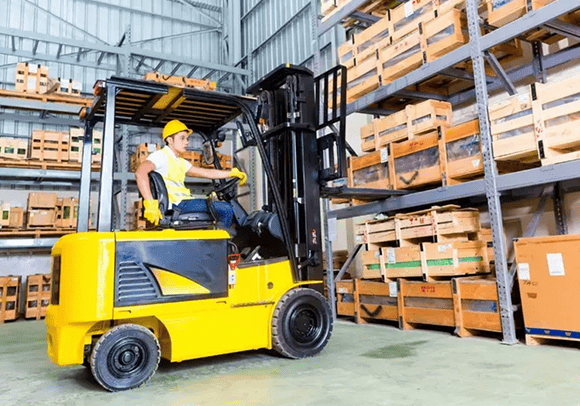
Our journey wouldn’t be complete without the all-mighty forklift, of course. Reach trucks for narrow aisles, rough terrain for outdoor yardwork, heavy-duty electric forklifts for moving pallets indoors… These machines come in all shapes and sizes.
For manufacturers, forklifts can even be used to transport raw materials to your production lines or move packaged goods to the shipping dock.
Docking Equipment | Warehouse Equipment For Loading Areas
The loading dock is by far the busiest (and most dangerous) place in your facility.
Dock levelers act as a bridge between your warehouse floor and trailer bed, while vehicle restraints keep your trucks from accidentally rolling around and into workers. And don’t forget the dock seals to prevent hot or cold air from escaping your building — that’s money on the loose.
Lifting Equipment | Specialty Warehouse Equipment
We discussed standard warehouse material handling equipment above, but what about short-distance pallet jacks? How about order pickers for manual lifting or small bin stackers?
Every lifting method was created with a specific weight and height in mind – don’t wear down your forklift by using it to pick up tiny items from the floor.
The Benefits of Utilizing Warehouse Equipment
Warehouse material handling equipment can do so much more than simply move boxes around. Operators who upgrade their warehouse facilities understand this equipment can change their business’s entire economic profile.
Warehouse Equipment Increases Worker Safety
Manual lifting is, again, the number one cause of workers’ comp accidents. Invest in some mechanical assistance to keep your employees safe!
From vacuum lifters to unload heavy boxes to pallet jacks that can run themselves, there are countless options for streamlining dangerous lifting operations.
Warehouse Equipment Creates Accurate Facilities
In a well-oiled warehouse, everything has its place. When pallets are stored in easily accessible racking systems and sent across the warehouse via conveyor lines, chances of losing inventory or damaging goods are minimal. Not only does this promote higher customer satisfaction percentages, but you will see a huge decrease in order returns.
Accurate shipments also fulfill faster, which is huge for any warehouse operating in the Dallas market.
Warehouse Equipment Generates Efficient Data
All the warehouse equipment listed above can connect to your warehouse management system (WMS). Seeing where every pallet in your facility is at any given moment not only shows you which areas of your floor are succeeding, but which aisles need improvement.
Choosing Warehouse Equipment | Know Your Capacity & Frequency
What is the heaviest load your facility will ever move? And how often will that load need to move? Over-specifying your machinery will leave you wasting your company’s capital. Under-specifying your warehouse equipment needs can lead to breakdowns and safety issues. If you deal with heavy manufacturing goods, be sure that the warehouse equipment you’re looking at can support that kind of weight capacity.
Measure Your Aisles & Floorspace
Obviously, the layout of your building will determine what warehouse equipment can fit inside. Need to squeeze a forklift down a 7-foot aisle? You’re going to need something much narrower than a counterbalance forklift. Measure your aisles width and length before buying anything. Also, don’t forget to measure the height of your ceilings when pre-planning for pallet racks and mezzanines.
Look For Brands You Can Trust to Maintain
All machinery breaks down… and when it does in a high-volume warehouse, decisions need to be made quickly. If your warehouse equipment supplier is hard to reach for maintenance or you have to drive across the state to get parts, those downtimes will kill your margins.
Always do your research — buy warehouse equipment from companies known for building durable products and offering maintenance support in your area.
Choose Your Power Wisely
Gas vs. electric? Electric vs. propane? With more businesses going green for sustainability and healthier indoor air, traditional internal combustion engine warehouse equipment is slowly being phased out.
Electric warehouse equipment should be your standard for anything indoors. It’s quieter, creates zero emissions, and maintenance is almost completely preventative. That being said, you’ll still need propane or diesel-powered machines for outside yard work or extreme heavy lifting.
Pro-Tip | Leave Room To Grow
Rule of thumb for warehouse managers: always lease or buy at least 15% more capacity than you think you’ll need. More shelf space in your pallet racks or extra battery life in your electric forklifts ensures that your business can meet seasonal spikes without killing your workflow.
Shop With Southwest Material Handling Co. | We Service What We Sell
Few industries are as specialized as industrial machinery. When dealing with heavy warehouse equipment that will be used day-in and day-out for years, it’s important to choose a partner familiar with the Texas market. At Southwest Material Handling Company, we service what we sell! Reach out to discuss your warehouse’s needs.
Whether you’re looking for that one specific piece of warehouse material handling equipment or an entire fleet of durable warehouse equipment in Dallas Texas, we can help your business meet its safety, efficiency, and ROI goals.